


Thank you for Subscribing to Energy Business Review Weekly Brief
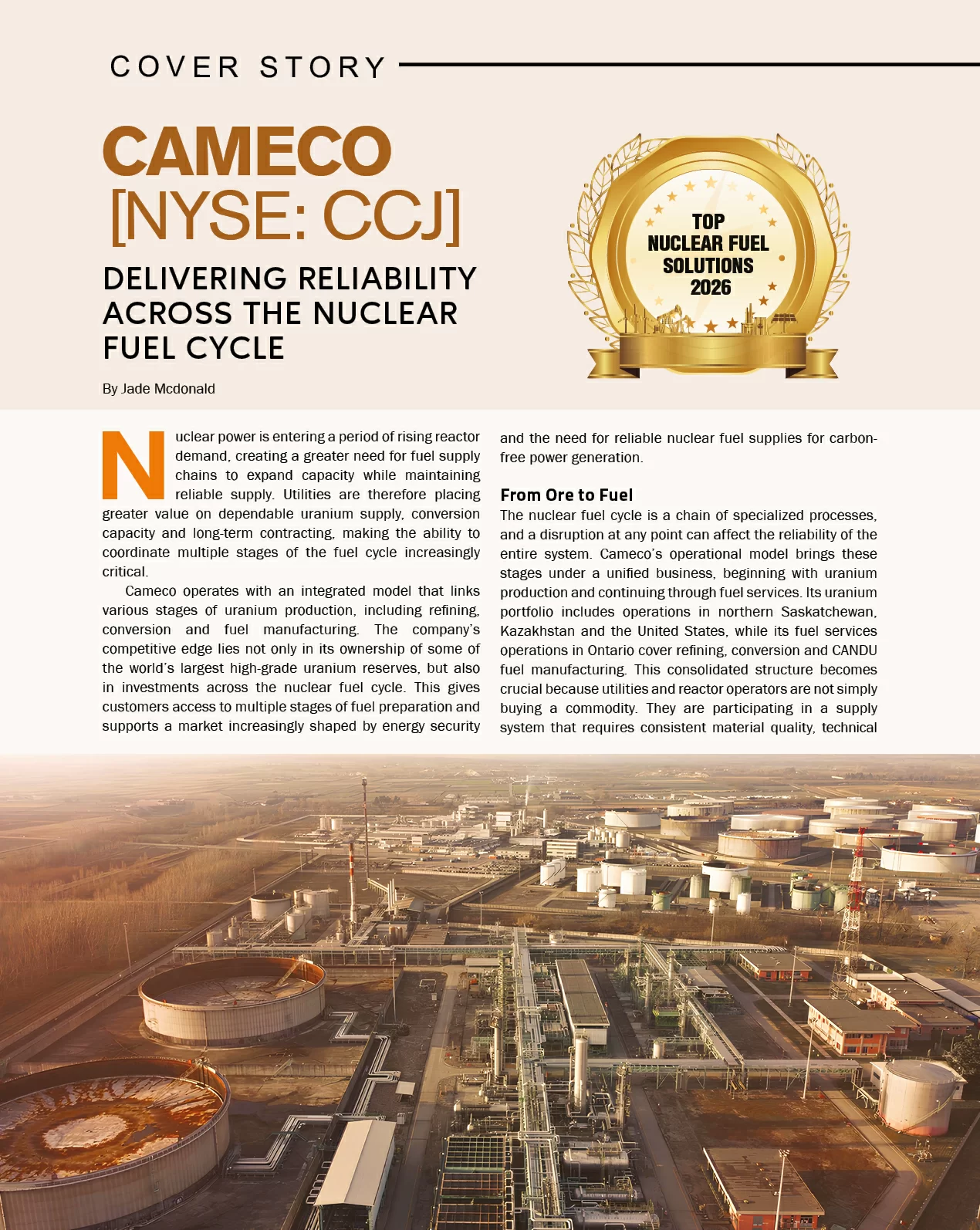
Cameco has been recognized by Energy Business Review Magazine as the exclusive recipient of “Top Nuclear Fuel Solutions 2026,” based on our proprietary methodology, reflecting its position in the industry, and is also named among “Top Fuel Delivery Services in Canada,” reflecting its broader leadership. This profile has been developed by the Energy Business Review research and editorial team based on insights from an interview with Tim Gitzel, CEO.
Nuclear power is entering a period of rising reactor demand, creating a greater need for fuel supply chains to expand capacity while maintaining reliable supply. Utilities are therefore placing greater value on dependable uranium supply, conversion capacity and long-term contracting, making the ability to coordinate multiple stages of the fuel cycle increasingly critical.
Supply reliability also depends on factors beyond contracts and production capacity. In May 2026, flooding in northern Saskatchewan caused a temporary interruption to the supply route serving McArthur River and Key Lake after the Smoothstone River Bridge was damaged. Cameco shifted to an alternative route and restored production activities while maintaining its consolidated 2026 production outlook. This highlights that maintaining dependable fuel supplies is not simply a question of having reserves in the ground. It also depends heavily on logistics, contingency planning and the ability to keep critical materials moving when infrastructure comes under pressure.
Cameco [NYSE: CCJ] operates with an integrated model that links various stages of uranium production, including refining, conversion and fuel manufacturing. The company’s competitive edge lies not only in its ownership of some of the world’s largest high-grade uranium reserves, but also in investments across the nuclear fuel cycle. This gives customers access to multiple stages of fuel preparation and supports a market increasingly shaped by energy security and the need for reliable nuclear fuel supplies for carbon-free power generation.
From Ore to Fuel
The nuclear fuel cycle is a chain of specialized processes, and a disruption at any point can affect the reliability of the entire system. Cameco’s operational model brings these stages under a unified business, beginning with uranium production and continuing through fuel services. Its uranium portfolio includes operations in northern Saskatchewan, Kazakhstan and the United States, while its fuel services operations in Ontario cover refining, conversion and CANDU fuel manufacturing. This consolidated structure becomes crucial because utilities and reactor operators are not simply buying a commodity. They are participating in a supply system that requires consistent material quality, technical processing and coordination between successive stages.
Being one of the largest global providers of uranium fuel, Cameco addresses this need for consistency through its large-scale production capacity and record of meeting supply commitments. In the company’s Blind River Refinery, natural uranium ore concentrates are refined to produce uranium trioxide, which is then transported to Port Hope for conversion into either uranium hexafluoride (UF₆) or natural uranium dioxide (UO₂). UO₂ proceeds through the fuel cycle to Cameco's fuel manufacturing arm, where it is used to manufacture fuel bundles for CANDU heavy water reactors. UF₆ moves to enrichment facilities for processing into fuel for light water reactors.
Strategy Built around Depth
Cameco has expanded beyond its core uranium and fuel services operations through strategic investments across the nuclear fuel cycle. Its 49 percent interest in Westinghouse provides exposure to reactor technology and nuclear services, while another 49 percent interest in Global Laser Enrichment gives it a leading position in uranium enrichment technology. The purpose is to participate in segments where customers require reliable supply, particularly when reliability can be affected by geopolitical developments.
Long-term contracts also form an essential component of this strategy. After meeting its 2025 delivery commitments, Cameco set its sights on delivering about 230 million pounds of uranium. It also had about 83 million kilograms of UF₆ under long-term contracts, supporting its fuel-services operations for years to come. These arrangements offer visibility into future demand while ensuring production and processing capacities are designed according to customer needs.
-
Cameco operates with an integrated model that links various stages of uranium production, including refining, conversion and fuel manufacturing.
Supply reliability also depends on factors beyond contracts and production capacity. In May 2026, flooding in northern Saskatchewan caused a temporary interruption to the supply route serving McArthur River and Key Lake after the Smoothstone River Bridge was damaged. Cameco shifted to an alternative route and restored production activities while maintaining its consolidated 2026 production outlook. This highlights that maintaining dependable fuel supplies is not simply a question of having reserves in the ground. It also depends heavily on logistics, contingency planning and the ability to keep critical materials moving when infrastructure comes under pressure.
Turning Scale into Reliability
Scale alone is not enough in the nuclear fuel space. It has to be backed by reliable supply to satisfy demand while providing competitive levelized costs and a clean emissions profile. The demand for fuel differs by reactor type, making uranium processing a complex operation that cannot be achieved through a standardized production process. Cameco manufactures UF₆ and UO₂ at its conversion plants, alongside CANDU fuel bundles and reactor components at its fuel manufacturing facilities. This allows Cameco to provide utilities and reactor operators with specialized processing and fuel-manufacturing services tailored to their needs across different stages of the fuel cycle.
The same principle applies to the company’s relationships across the nuclear industry. The second quarter of 2026 saw 2.3 million pounds of packaged U₃O₈ production from McArthur River and Key Lake, while Cigar Lake’s packaged production was 1.6 million pounds. The company projects 19.5 to 21.5 million pounds of U₃O₈ production in 2026 in its uranium segment.
Its investment in Westinghouse adds another dimension by connecting fuel supply with reactor technology and services. The partnership acts as a major asset within Cameco’s nuclear portfolio, while Global Laser Enrichment provides exposure to enrichment technology through SILEX. This creates a wider position across the nuclear ecosystem at a time when governments and utilities are reassessing supply chains, reactor deployment and domestic fuel security. The alliances also give the company an additional avenue for growth in the nuclear fuel sector beyond uranium production alone.
Recognized as a Top Nuclear Fuel Solutions 2026, Cameco’s integrated position across uranium production, conversion, fuel manufacturing and strategic nuclear investments reflects its ability to support customers across an increasingly interconnected fuel cycle.
Company
Cameco
Management
Tim Gitzel, CEO
Description
Founded in 1988 in Canada, Cameco is a leading commercial provider of uranium fuel for clean nuclear energy. Led by CEO Tim Gitzel, the company leverages high-grade reserves and deep fuel cycle expertise to help global utilities deliver reliable energy solutions.
