

Thank you for Subscribing to Energy Business Review Weekly Brief


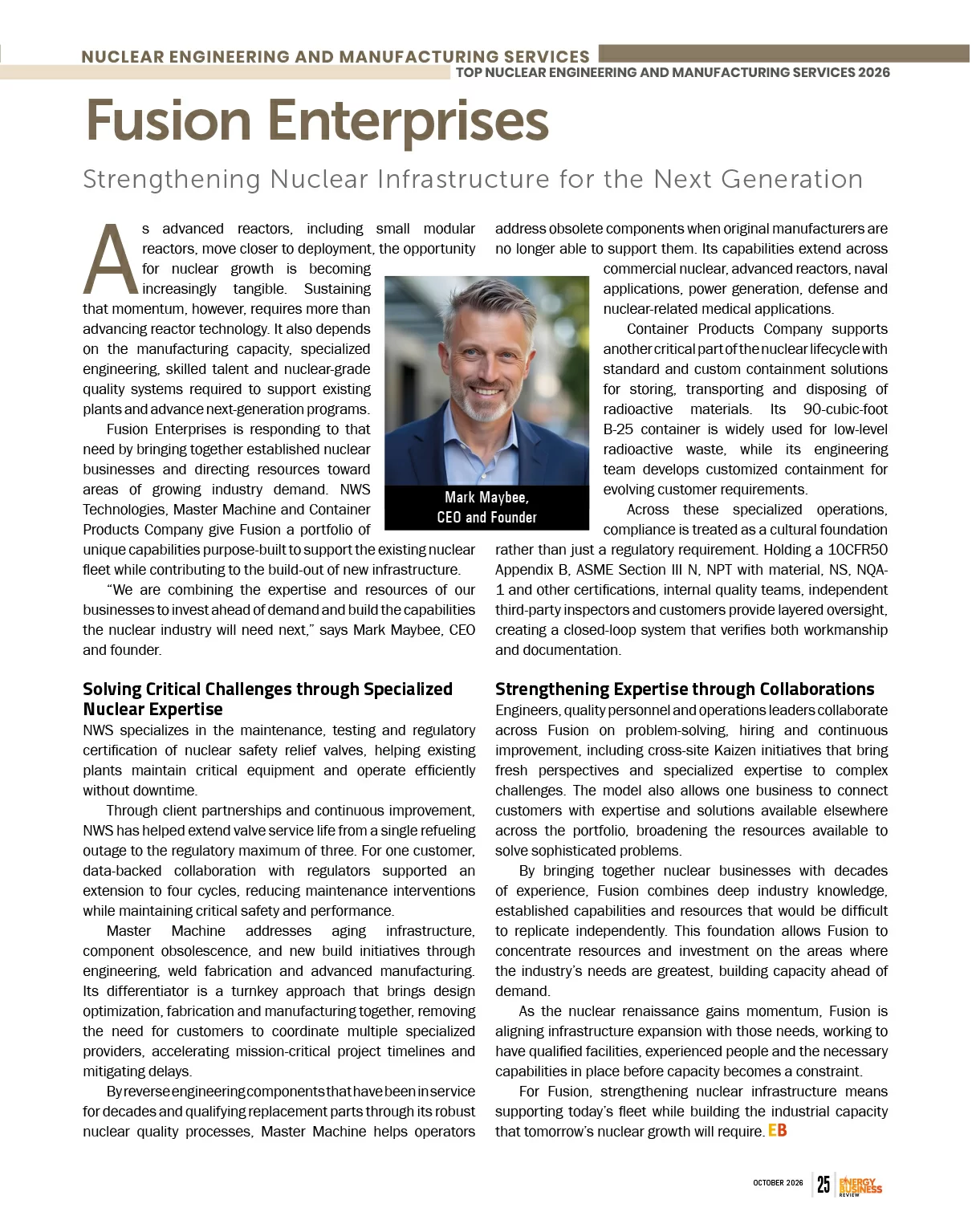
 Mark Maybee, CEO and Founder
As advanced reactors, including small modular reactors, move closer to deployment, the opportunity for nuclear growth is becoming increasingly tangible. Sustaining that momentum, however, requires more than advancing reactor technology. It also depends on the manufacturing capacity, specialized engineering, skilled talent and nuclear-grade quality systems required to support existing plants and advance next-generation programs.
Container Products Company supports another critical part of the nuclear lifecycle with standard and custom containment solutions for storing, transporting and disposing of radioactive materials. Its 90-cubic-foot B-25 container is widely used for low-level radioactive waste, while its engineering team develops customized containment for evolving customer requirements.
Fusion Enterprises is responding to that need by bringing together established nuclear businesses and directing resources toward areas of growing industry demand. NWS Technologies, Master Machine and Container Products Company give Fusion a portfolio of unique capabilities purpose-built to support the existing nuclear fleet while contributing to the build-out of new infrastructure.
“We are combining the expertise and resources of our businesses to invest ahead of demand and build the capabilities the nuclear industry will need next,” says Mark Maybee, CEO and founder.
Solving Critical Challenges through Specialized Nuclear Expertise
NWS specializes in the maintenance, testing and regulatory certification of nuclear safety relief valves, helping existing plants maintain critical equipment and operate efficiently without downtime.
Through client partnerships and continuous improvement, NWS has helped extend valve service life from a single refueling outage to the regulatory maximum of three. For one customer, data-backed collaboration with regulators supported an extension to four cycles, reducing maintenance interventions while maintaining critical safety and performance.
Master Machine addresses aging infrastructure, component obsolescence, and new build initiatives through engineering, weld fabrication and advanced manufacturing. Its differentiator is a turnkey approach that brings design optimization, fabrication and manufacturing together, removing the need for customers to coordinate multiple specialized providers, accelerating mission-critical project timelines and mitigating delays.
By reverse engineering components that have been in service for decades and qualifying replacement parts through its robust nuclear quality processes, Master Machine helps operators address obsolete components when original manufacturers are no longer able to support them. Its capabilities extend across commercial nuclear, advanced reactors, naval applications, power generation, defense and nuclear-related medical applications.
-
We are combining the expertise and resources of our businesses to invest ahead of demand and build the capabilities the nuclear industry will need next.
Container Products Company supports another critical part of the nuclear lifecycle with standard and custom containment solutions for storing, transporting and disposing of radioactive materials. Its 90-cubic-foot B-25 container is widely used for low-level radioactive waste, while its engineering team develops customized containment for evolving customer requirements.
Across these specialized operations, compliance is treated as a cultural foundation rather than just a regulatory requirement. Holding a 10CFR50 Appendix B, ASME Section III N, NPT with material, NS, NQA1 and other certifications, internal quality teams, independent third-party inspectors and customers provide layered oversight, creating a closed-loop system that verifies both workmanship and documentation.
Strengthening Expertise through Collaborations
Engineers, quality personnel and operations leaders collaborate across Fusion on problem-solving, hiring and continuous improvement, including cross-site Kaizen initiatives that bring fresh perspectives and specialized expertise to complex challenges. The model also allows one business to connect customers with expertise and solutions available elsewhere across the portfolio, broadening the resources available to solve sophisticated problems.
By bringing together nuclear businesses with decades of experience, Fusion combines deep industry knowledge, established capabilities and resources that would be difficult to replicate independently. This foundation allows Fusion to concentrate resources and investment on the areas where the industry’s needs are greatest, building capacity ahead of demand.
As the nuclear renaissance gains momentum, Fusion is aligning infrastructure expansion with those needs, working to have qualified facilities, experienced people and the necessary capabilities in place before capacity becomes a constraint.
For Fusion, strengthening nuclear infrastructure means supporting today’s fleet while building the industrial capacity that tomorrow’s nuclear growth will require.
Engineering Capacity for Nuclear Growth
Nuclear operators are being asked to extend the life of established assets while preparing for a new build cycle that demands more qualified manufacturing capacity. The pressure is not limited to reactor projects. Existing plants still depend on equipment that may be decades old, supported by shrinking OEM networks and constrained replacement options. A vendor that cannot work within nuclear quality programs, preserve documentation discipline and respond to component obsolescence can create schedule exposure long before a part reaches the plant floor.
Supplier qualification, therefore, carries more weight than ordinary manufacturing competence. Buyers need evidence that quality requirements are embedded in hiring, training, inspection and recordkeeping rather than treated as a final review step. Nuclear work often passes through layered oversight, including internal quality functions and customer surveillance. Engineering depth also matters because older assets rarely fail in convenient ways. A replacement may require reverse engineering or commercial-grade dedication, sometimes paired with design changes or qualified replacement sourcing within the applicable quality framework.
Component availability also changes the economics of maintenance. Plants built around equipment installed 40 or 50 years ago may face failures after the original supplier has exited the market or stopped supporting the design. Waiting for a like-for-like replacement can turn an equipment problem into an outage problem. Engineering providers need enough nuclear-grade expertise to determine whether an existing component can be recreated, upgraded or replaced through an accepted dedication process without weakening traceability or plant confidence.
[QUOTE1_Replace]
Capacity is becoming another pressure point. Advanced reactor programs and infrastructure expansion are increasing demand for qualified facility space and specialized labor, while existing fleets still require maintenance support. Supplier depth matters more in that environment than a narrow machining or fabrication capability. Buyers should look for providers that can absorb complicated work, move technical knowledge across projects and support both current plant requirements and new infrastructure without forcing every problem into a single service line.
Workforce continuity deserves similar scrutiny. Small specialist suppliers can hold substantial technical knowledge in a limited group of people, increasing exposure when experienced personnel leave. Providers that support talent mobility and cross-site technical collaboration have more options for retaining nuclear expertise as workload and capacity demands rise.
The service model should also reduce handoffs around critical equipment. Safety relief valves sit inside tightly controlled service cycles where workmanship and documentation affect return-to-service timing. Radioactive material handling creates a different set of constraints, particularly around containers used for storage and transport. Manufacturing partners that can address these requirements through qualified processes and engineering support can simplify vendor coordination without diluting the controls nuclear programs require.
Fusion Enterprises fits this buying logic through three specialized businesses working under one ownership structure. Its NWS Technologies supports the required safety relief valve service and recertification for nuclear facilities. Master Machine handles engineering, reverse engineering, commercial-grade dedication and precision manufacturing for nuclear applications, while Container Products Company supplies standard and custom containment for radioactive material storage and transport. Fusion Enterprises brings shared technical resources and cross-company problem-solving to work governed by nuclear quality programs. For buyers balancing aging-plant support with new nuclear construction, that breadth makes it a practical provider to consider.
...Read more
Nuclear Engineering and Manufacturing Services Info
Q1
What Are Nuclear Engineering and Manufacturing Services?
Nuclear Engineering and Manufacturing Services cover specialized engineering, fabrication, maintenance, component replacement and manufacturing work required to support nuclear facilities. The category is particularly important as operators manage aging equipment while new reactor programs increase demand for qualified industrial capacity. These services can include reverse engineering, precision manufacturing, weld fabrication, equipment qualification, safety relief valve work and radioactive-material containment, with nuclear quality requirements embedded throughout the process.
Q2
How Does Fusion Enterprises Apply Nuclear Engineering and Manufacturing Services?
Fusion Enterprises brings together NWS Technologies, Master Machine and Container Products Company to address different requirements across the nuclear lifecycle. NWS focuses on maintenance, testing and regulatory certification of nuclear safety relief valves. Master Machine combines design optimization, weld fabrication and advanced manufacturing, while Container Products Company provides standard and custom containment for radioactive materials. Together, these businesses give Fusion Enterprises a broader industrial platform for maintenance and infrastructure requirements.
Q3
Why Does Component Obsolescence Matter In Nuclear Facilities?
Component obsolescence can become an operational and scheduling issue when equipment has been in service for decades and original manufacturers no longer support it. Nuclear Engineering and Manufacturing Services can address this gap through reverse engineering, qualified replacement manufacturing and commercial-grade dedication where applicable. The objective is not simply to reproduce a component, but to preserve the traceability, documentation and quality controls required for nuclear applications.
Q4
What Quality Factors Should Buyers Examine?
Quality programs matter in Nuclear Engineering and Manufacturing Services because nuclear components must meet strict technical and regulatory requirements. Buyers should look at qualified processes, clear documentation, inspection capabilities and relevant certifications. Fusion Enterprises holds certifications, including 10CFR50 Appendix B, ASME Section III N, NPT with material, NS and NQA1. Its quality teams, independent inspectors and customer oversight check the work at different stages and support consistent quality across its operations.
Q5
How Can These Services Reduce Maintenance And Supply-Chain Pressure?
Nuclear Engineering and Manufacturing Services can address pressure created by limited replacement options, specialized labor requirements and long procurement cycles. A provider with engineering and manufacturing capabilities can evaluate obsolete equipment, develop qualified replacements and coordinate fabrication without sending every stage to a separate specialist. At NWS, client and regulatory collaboration has supported extending valve service life from one refueling outage to three, and in one case to four cycles, reducing maintenance interventions.
Q6
What Role Will Nuclear Engineering and Manufacturing Services Play In Future Nuclear Growth?
As advanced reactors and infrastructure projects progress, Nuclear Engineering and Manufacturing Services will remain relevant alongside continued support for existing plants. The challenge is building qualified capacity before demand becomes a constraint. Fusion Enterprises is investing in facilities, people and capabilities while encouraging cross-site collaboration among engineers, quality personnel and operations leaders. Its model connects current fleet requirements with preparation for new nuclear infrastructure rather than treating maintenance and future construction as separate industrial needs.
Company
Fusion Enterprises
Management
Mark Maybee, CEO and Founder
Description
Fusion Enterprises supports the nuclear industry through three specialized businesses that deliver integrated maintenance, engineering, manufacturing and containment solutions. By combining technical expertise with investment capacity, it helps clients maintain existing infrastructure while advancing the next generation of technologies.
