

Thank you for Subscribing to Energy Business Review Weekly Brief


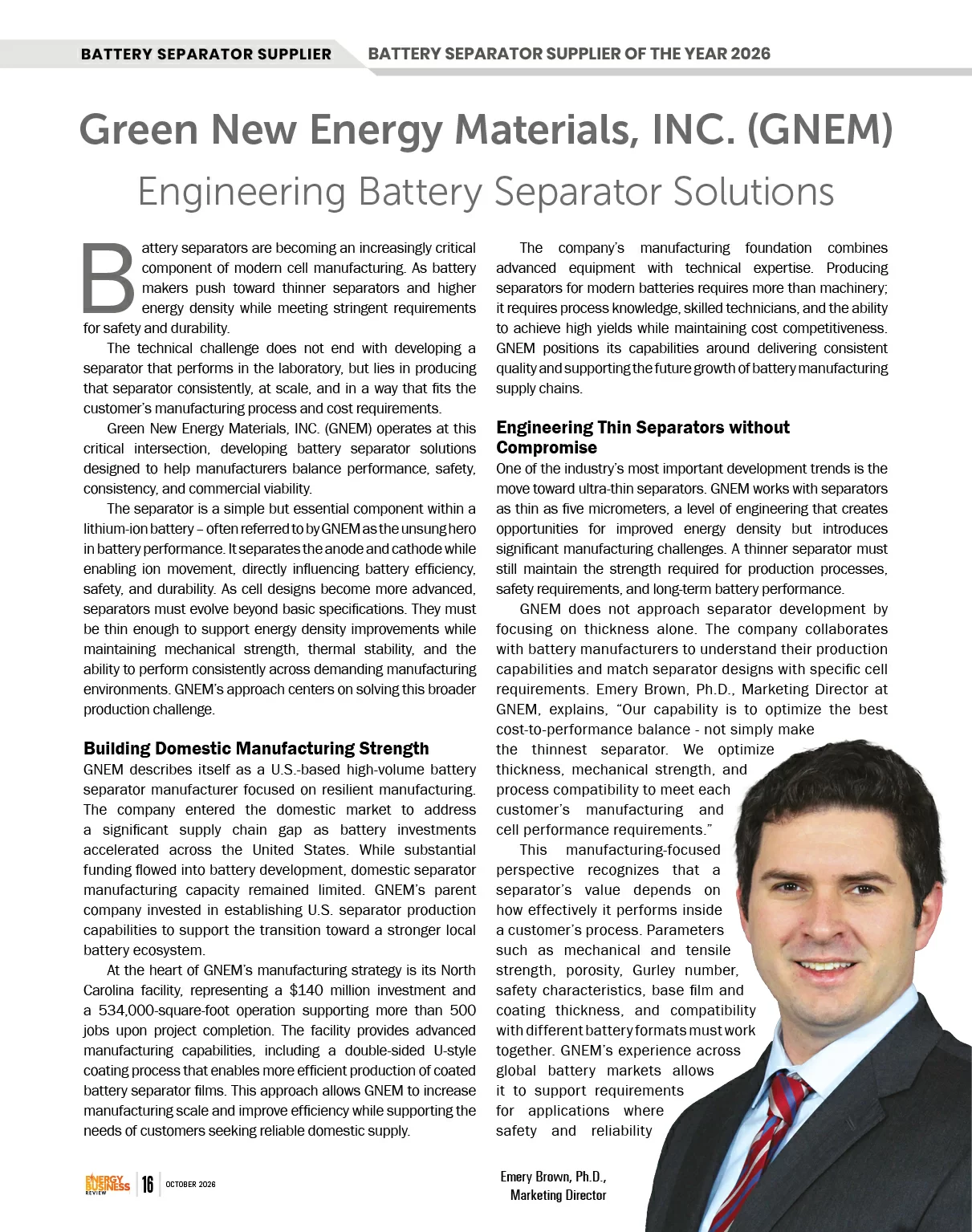
 Emery Brown, Ph.D., Marketing Director
Battery separators are becoming an increasingly critical component of modern cell manufacturing. As battery makers push toward thinner separators and higher energy density while meeting stringent requirements for safety and durability.
The technical challenge does not end with developing a separator that performs in the laboratory, but lies in producing that separator consistently, at scale, and in a way that fits the customer’s manufacturing process and cost requirements.
Green New Energy Materials, INC. (GNEM) operates at this critical intersection, developing battery separator solutions designed to help manufacturers balance performance, safety, consistency, and commercial viability.
The separator is a simple but essential component within a lithium-ion battery – often referred to by GNEM as the unsung hero in battery performance. It separates the anode and cathode while enabling ion movement, directly influencing battery efficiency, safety, and durability. As cell designs become more advanced, separators must evolve beyond basic specifications. They must be thin enough to support energy density improvements while maintaining mechanical strength, thermal stability, and the ability to perform consistently across demanding manufacturing environments. GNEM’s approach centers on solving this broader production challenge.
Building Domestic Manufacturing Strength
GNEM describes itself as a U.S.-based high-volume battery separator manufacturer focused on resilient manufacturing. The company entered the domestic market to address a significant supply chain gap as battery investments accelerated across the United States. While substantial funding flowed into battery development, domestic separator manufacturing capacity remained limited. GNEM’s parent company invested in establishing U.S. separator production capabilities to support the transition toward a stronger local battery ecosystem.
At the heart of GNEM’s manufacturing strategy is its North Carolina facility, representing a $140 million investment and a 534,000-square-foot operation supporting more than 500 jobs upon project completion. The facility provides advanced manufacturing capabilities, including a double-sided U-style coating process that enables more efficient production of coated battery separator films. This approach allows GNEM to increase manufacturing scale and improve efficiency while supporting the needs of customers seeking reliable domestic supply.
The company’s manufacturing foundation combines advanced equipment with technical expertise. Producing separators for modern batteries requires more than machinery; it requires process knowledge, skilled technicians, and the ability to achieve high yields while maintaining cost competitiveness. GNEM positions its capabilities around delivering consistent quality and supporting the future growth of battery manufacturing supply chains.
Engineering Thin Separators without Compromise
One of the industry’s most important development trends is the move toward ultra-thin separators. GNEM works with separators as thin as five micrometers, a level of engineering that creates opportunities for improved energy density but introduces significant manufacturing challenges. A thinner separator must still maintain the strength required for production processes, safety requirements, and long-term battery performance.
GNEM does not approach separator development by focusing on thickness alone. The company collaborates with battery manufacturers to understand their production capabilities and match separator designs with specific cell requirements. Emery Brown, Ph.D., Marketing Director at GNEM, explains, “Our capability is to optimize the best cost-to-performance balance - not simply make the thinnest separator. We optimize thickness, mechanical strength, and process compatibility to meet each customer’s manufacturing and cell performance requirements.”
This manufacturing-focused perspective recognizes that a separator’s value depends on how effectively it performs inside a customer’s process. Parameters such as mechanical and tensile strength, porosity, Gurley number, safety characteristics, base film and coating thickness, and compatibility with different battery formats must work together. GNEM’s experience across global battery markets allows it to support requirements for applications where safety and reliability are especially critical, including electric vehicles and energy storage systems.
Customization Designed for Commercial Success
GNEM’s differentiation comes from its collaborative approach to product development. Rather than treating customization as simply creating a separator around every requested specification, the company works with customers to identify solutions that can be manufactured efficiently and economically.
The company maintains thousands of separator configurations covering a wide range of coating types, thicknesses, and porosity levels. Through close collaboration between GNEM’s technical teams and customer engineering teams, the company evaluates suitable products for specific battery systems. Qualification is a detailed process involving sampling and validation, often requiring six months to a year before large-scale orders are placed.
-
Our capability is to optimize the best cost-to-performance balance - not simply make the thinnest separator. We optimize thickness, mechanical strength, and process compatibility to meet each customer’s manufacturing and cell performance requirements.
This process considers the complete battery manufacturing environment. GNEM evaluates factors such as winding speed, cell format, and assembly methods, including cylindrical, pouch, and prismatic designs. These details influence separator selection because each manufacturing process places different demands on separator performance and strength.
The company also brings an advisory role to customer relationships. GNEM helps customers understand available options and guides them toward solutions that meet technical requirements without creating unnecessary complexity or excessive cost. A highly specialized separator may satisfy performance goals but become difficult to manufacture at commercial volumes. GNEM focuses on finding the right balance between engineering requirements, production realities, and business outcomes.
Supporting Diverse Battery Applications
Battery separator requirements vary significantly depending on the application. Electric vehicle manufacturers may prioritize different combinations of safety, charging speed, range, and cost depending on their vehicle designs. Energy storage systems place greater emphasis on safety, longevity, and return on investment because of their large-scale deployment and operational expectations.
GNEM’s broad product portfolio and ability to collaborate across applications provide flexibility in addressing these different requirements. The company’s advantage comes from matching separator technology with each customer’s manufacturing capabilities while delivering solutions that remain commercially practical.
The company’s broader experience includes solutions developed for complex battery challenges. One example involved supporting an electric vehicle manufacturer seeking improved charging performance. The collaboration contributed to the development of a nanofiber coating series that improved porosity, wetting, and ion mobility. Another example involved a customer with a unique cell design experiencing winding issues and separator damage. A specialized edge bonding solution helped integrate the separator into the manufacturing process. These examples demonstrate GNEM’s focus on solving production challenges, not merely adjusting specifications.
Positioned for the Next Phase of Battery Growth
As the battery market evolves, GNEM continues to expand its capabilities alongside changing industry demands. The company sees continued opportunities in both electric vehicles and energy storage systems, with market dynamics shifting as manufacturers adapt to new priorities. GNEM plans to expand capacity as needed and explore additional research and development capabilities in future phases.
The company’s position is strengthened by its ability to combine global separator expertise with U.S. manufacturing presence. GNEM identifies consistency, quality, and scalable production as critical advantages in a market where battery manufacturers require dependable supply partners.
Battery innovation is often measured by the performance of the finished cell, but manufacturing determines whether that innovation can reach the market. GNEM represents a manufacturing-led approach to separator development, where technology decisions are evaluated through the lens of real-world production. As the industry moves from ambitious battery targets toward commercial-scale execution, separator leadership will depend not only on how advanced a material can become, but on whether it can be produced consistently, safely, and economically.
GNEM’s role in this transition reflects a larger shift in battery manufacturing: transforming technical possibilities into reliable industrial solutions. This commitment defines GNEM’s manufacturing vision.
Separator Supply Built Around Production Reality
Separator purchasing looks straightforward on a specification sheet. The difficulty appears when a film that meets nominal thickness and porosity targets reaches a high-speed cell line and starts creating winding defects or unstable yield. Ultra-thin designs sharpen that exposure. Reducing separator thickness may improve energy density, yet the gain matters only if the film retains the mechanical behavior required by the cell architecture and the manufacturing process. Procurement teams therefore need to evaluate the separator as part of the production system rather than as an isolated component.
Manufacturing fit deserves close scrutiny because cell makers do not run identical processes. Winding speed, cell format, folding method and line tension alter how a separator behaves under production conditions. A supplier should be able to match thickness and porosity to those constraints while preserving appropriate mechanical strength. Qualification work also needs to reflect the intended chemistry and performance target. A technically attractive film that forces slower line speeds or creates excess scrap may erase its economic advantage before commercial production begins.
Consistency becomes more consequential as volumes rise. Micron-scale variation that looks minor in laboratory samples may become expensive when repeated across large runs. Buyers should examine control over coating uniformity and base-film consistency, then ask how those controls hold up when output expands. Capacity matters in the same discussion. Buyers should also test whether capacity commitments are tied to qualified lines rather than headline nameplate output, especially during ramp-up. A separator source that qualifies successfully but struggles to reproduce the same material at scale exposes a battery program to rework and scheduling pressure. Domestic production may also shorten the distance between engineering teams and supply, although proximity is useful only when paired with stable process control.
Customization presents a different tradeoff. Battery developers often arrive with demanding targets, but highly specific material designs may add minimum-order burdens and unnecessary cost. A capable supplier should know when an existing product is close enough to the application and when modification is justified. The distinction matters during lengthy qualification cycles because each additional change may restart part of the evaluation. Technical collaboration should narrow the specification rather than expand it without discipline.
“Green New Energy Materials development process matches separator thickness, porosity, coating behavior and mechanical strength to cell performance and manufacturing conditions.”
Application priorities further complicate selection. Electric-vehicle programs may emphasize fast-charge behavior alongside safety, while stationary storage frequently places greater weight on cycle life and system economics. A separator supplier therefore needs enough technical range to work across different cell designs without treating every project as a clean-sheet development. The strongest fit is usually found where product breadth, manufacturing knowledge, qualification discipline and scale control meet the buyer’s actual process.
Green New Energy Materials (GNEM) merits consideration as a premier choice for buyers that place production fit and domestic supply at the center of separator sourcing. Its North Carolina manufacturing base uses a double-sided U-style coating configuration designed to raise throughput while reducing turnover between coating steps. Its development process matches separator thickness, porosity, coating behavior and mechanical strength to cell performance and manufacturing conditions. Green New Energy Materials (GNEM) also maintains thousands of separator products, including ultra-thin options down to five micrometers, giving technical teams room to select or adjust a design without defaulting to costly over-customization. That combination makes it a practical recommendation where qualification depth and repeatable scale carry equal weight.
...Read more
Battery Separator Suppliers Info
Q1
What Role Do Battery Separator Suppliers Play in Lithium-Ion Battery Manufacturing?
Suppliers of battery separators supply an essential substance that permits ions to flow between the anode and cathode of a battery while keeping them apart. Their work has an impact on manufacturability, durability, efficiency, and safety. Suppliers of contemporary lithium-ion battery separators must strike a compromise between thinness, mechanical strength, thermal stability, porosity, and uniform coating quality. As manufacturers strive for greater energy density without posing production risks or jeopardizing long-term cell performance, these issues become more crucial.
Q2
How Does Green New Energy Materials, INC. (GNEM) Support Scalable Separator Manufacturing?
Battery Separator Suppliers must translate material performance into repeatable production. Green New Energy Materials, INC. (GNEM) supports this through a North Carolina manufacturing facility representing a $140 million investment and roughly 534,000 square feet of operations. The site includes a double-sided U-style coating process for coated battery separator films. GNEM also works with separators as thin as five micrometers, combining high-volume separator manufacturing with process requirements tied to strength, consistency and commercial-scale production.
Q3
What Technical Factors Matter When Evaluating Separator Performance?
Battery Separator Suppliers are evaluated on more than separator thickness. Important considerations include tensile and mechanical strength, porosity, Gurley characteristics, thermal stability, base-film thickness, coating thickness and compatibility with the intended cell design. Separator manufacturing must also account for winding speed, assembly methods and production tolerances. Effective lithium-ion battery separators need to perform reliably inside real manufacturing environments, where material consistency can influence both cell safety and the efficiency of large-scale production.
Q4
How Can Separator Selection Support Safety, Efficiency and Battery Life?
Battery Separator Suppliers help manufacturers balance several performance priorities at once. A separator must prevent direct contact between electrodes while supporting efficient ion movement, stable operation and resistance to thermal stress. Coated battery separators can add functional properties related to stability, adhesion and electrochemical performance. The right design also needs to fit the battery format and production process. This makes separator selection a combined materials, engineering and manufacturing decision rather than a specification based on thickness alone.
Q5
How Does GNEM Approach Custom Battery Separator Requirements?
Battery Separator Suppliers often need to match product characteristics to specific manufacturing conditions. GNEM maintains more than 3,000 separator configurations spanning different coatings, thicknesses and porosity levels, giving its technical teams a broad base for product matching. It collaborates with customer engineering teams during sampling and validation and considers factors such as winding speed and cylindrical, pouch or prismatic formats. Its work also includes specialized nanofiber coating and edge-bonding solutions developed around documented production challenges.
Q6
What Should Manufacturers Consider When Choosing a Separator Supply Partner?
Battery Separator Suppliers should be assessed on their ability to combine material performance with consistent, scalable production. Buyers should consider quality control, manufacturing capacity, coating capabilities, product breadth and the supplier’s ability to align separator properties with actual cell-production requirements. Reliable separator manufacturing also depends on process knowledge and repeatability, especially when working with thin or coated battery separators. The strongest fit is a supplier that can support technical qualification while keeping safety, performance, manufacturability and cost in balance.
Company
Green New Energy Materials, INC. (GNEM)
Management
Emery Brown, Ph.D., Marketing Director
Description
Green New Energy Materials (GNEM) is redefining battery separator manufacturing through advanced domestic production, deep customer collaboration, and scalable solutions. By balancing thin-film performance, safety, strength, and cost, GNEM helps battery manufacturers transform ambitious designs into reliable, high-volume production outcomes.
